NVIDIA HGX B300 · Blackwell Ultra
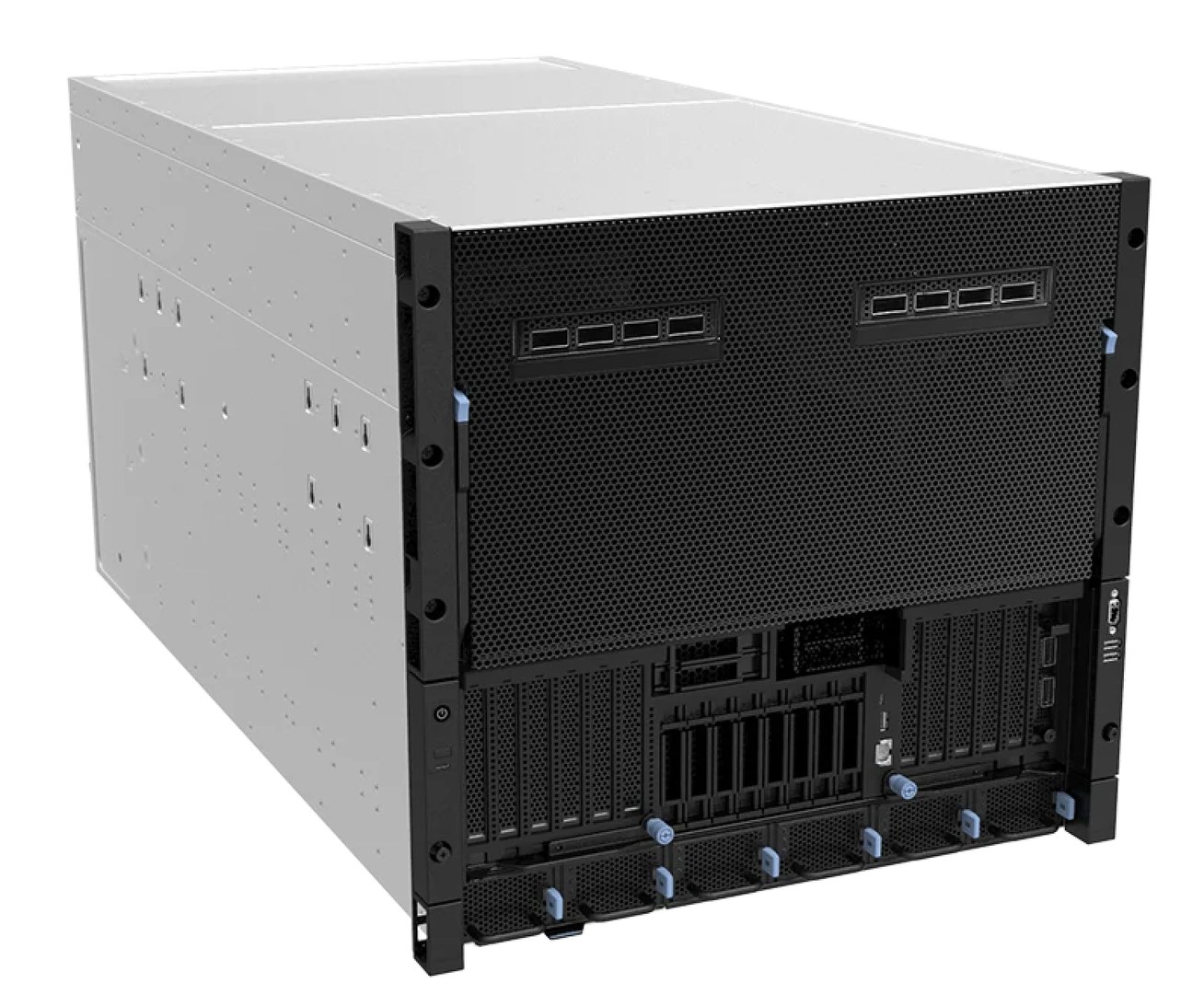
Eight NVIDIA Blackwell Ultra GPUs on a single baseboard, wired by fifth generation NVLink. The most capable AI node NVIDIA ships today, deployed in Vancouver and contracted to you.
8x
Blackwell Ultra GPUs per node
2.1TB
HBM3e memory per node
144PF
FP4 tensor core, sparse
14.4TB/s
Aggregate NVLink bandwidth
The hardware
The HGX B300 puts eight Blackwell Ultra SXM modules on a single baseboard and connects every GPU to every other GPU through a dual NVLink 5 switch system. Each link runs at 1.8 TB/s, and the fabric carries 14.4 TB/s in aggregate.
Because the interconnect is not a bottleneck, a model spread across all eight GPUs behaves more like one device with 2.1 terabytes of memory than like eight devices passing tensors over a network. That matters most for large mixture of experts models, long context windows and large training runs.
Blackwell Ultra adds roughly twice the attention layer performance of standard Blackwell and 1.5 times the dense FP4 throughput. For reasoning models and long sequence inference, that is where the gain shows up.
On a B300 node the interconnect is wide enough that the eight GPUs behave as one pool of memory rather than eight separate destinations.
Specifications
Platform figures as published by NVIDIA for the HGX B300. Freyr deployments are configured to customer specification, so CPU, local storage and fabric topology are set during the design phase rather than fixed here.
| Specification | HGX B300 |
|---|---|
| Form factor | 8x NVIDIA Blackwell Ultra SXM |
| Total GPU memory | 2.1 TB HBM3e |
| FP4 tensor core | 144 PFLOPS sparse · 108 PFLOPS dense |
| FP8 / FP6 tensor core | 72 PFLOPS sparse |
| INT8 tensor core | 3 POPS sparse |
| FP16 / BF16 tensor core | 36 PFLOPS sparse |
| TF32 tensor core | 18 PFLOPS sparse |
| FP32 | 600 TFLOPS |
| FP64 / FP64 tensor core | 10 TFLOPS |
| NVLink generation | Fifth generation, NVLink 5 Switch |
| NVLink GPU-to-GPU bandwidth | 1.8 TB/s |
| Total NVLink bandwidth | 14.4 TB/s |
| Networking bandwidth | 1.6 TB/s · 8x NVIDIA ConnectX-8 |
| Attention performance | 2x NVIDIA Blackwell |
| Tenancy | Single tenant, bare metal, no hypervisor |
| Location | Vancouver, British Columbia · Tier III |
| Term | Reserved, one to five years |
| Deployment | Approximately five weeks from signature |
Platform figures per the NVIDIA HGX platform specifications. Sparse and dense figures are noted where NVIDIA distinguishes them. The final four rows describe the Freyr deployment rather than the NVIDIA platform.
What Freyr adds
Anyone with an allocation can quote you a B300. What differs is who else is on the box, where it sits, and whether it is still yours in eighteen months.
01
No hypervisor between your code and the hardware, and no other tenant on your baseboard. Nothing else competes for the node, so it performs the same in year three as on day one.
02
Tier III colocation in Vancouver, on a grid that is roughly ninety percent hydroelectric. Data processed on Freyr hardware stays in the facility you contracted.
03
Storage profile, interconnect topology and CPU pairing are set during design rather than worked around after delivery. Roughly five weeks from signature to a cluster you can log into.
Use cases
Blackwell Ultra roughly doubles attention layer throughput against standard Blackwell. Long chains of thought and multi step agent loops spend most of their time in that path, so the gain shows up in tokens per second.
72 PFLOPS of FP8 and 2.1 TB of pooled HBM3e per node, with 14.4 TB/s of NVLink behind it. Models that would need heavy quantisation or sharding elsewhere fit and train here without it.
Health, financial and public sector work that cannot leave the country it is regulated in, or share a physical host. Single tenant hardware in a named Vancouver facility gives your privacy officer a clear answer.
We will come back with a node count and a configuration, and tell you if the B300 is not the right part for the job. Capacity goes to whoever commits first, and the 2026 deployment window is open.
John Kinash · Business Development, North America · john.kinash@freyrtech.ai · 778 872 8288
